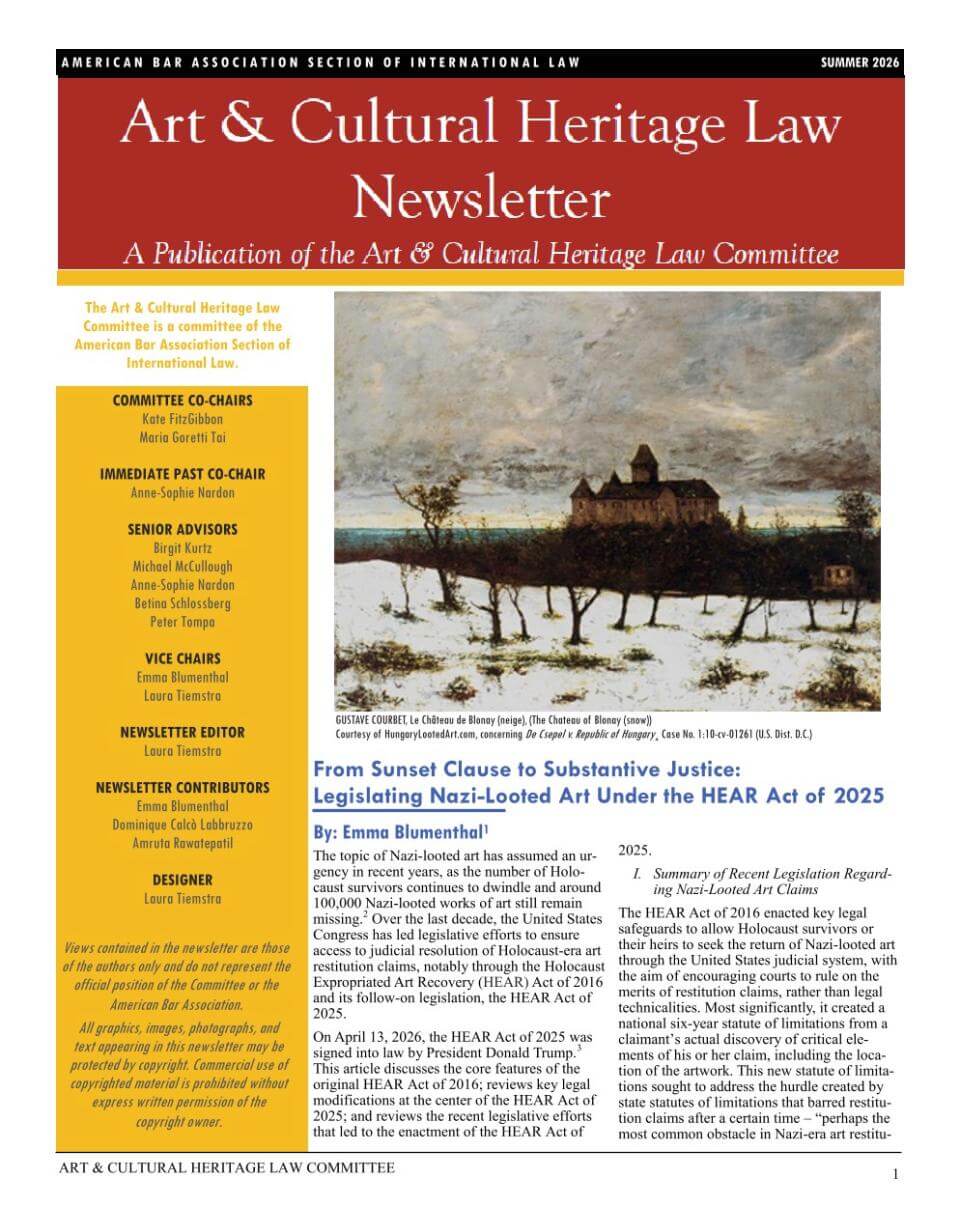
Boletín del Comité de Derecho del Arte y Patrimonio Cultural
Abstract
by: Wilfredo A. Chau
w.chau@iricas.org
The newsletter of the Art and Cultural Heritage Law Committee (ACHC) of the #AmericanBarAssociation (ABA) addresses three interesting topics:
✅ The first part deals with the pieces of art illicitly appropriated and looted scenarios of international conflict. The article develops a detailed chronological summary of the #LeydeRecuperacióndeArteExpropiadodelHolocausto (HEAR), the intervening actors, the drafting of the 2025 succession legislation, and the enactment of the #HEAR Law of April 13, 2026 by Donald Trump.
✅ As a second article, it addresses a topic directly linked to #indígenas native peoples #UNDRIP in relation to the protection of millenary knowledge known in the international framework as “traditional knowledge” TK. It explains how the Western world takes a step of detachment on the part of the World Intellectual Property Organization #WIPO in the area of Associated Genetic Resources Traditional Knowledge #GRATK of Indigenous Peoples and Local Communities #IPLCs in order to protect the role of IPLCs in the process of registration of #patentes. In this way, the Treaty on Intellectual Property of Genetic Resources and Associated with Traditional Knowledge (2024) was born with the aim of improving transparency in invention, legal certainty in relation to originality, a novel contribution. This international legal instrument is binding with the Nagoya Treaty (2010) from which the #ConveniosobrelaDiversidadBiológica (CBD) was born, which seeks an equitable distribution of benefits of genetic resources in relation to traditional knowledge. The article provides much more information on the challenges by 2025.
✅ The last article addresses the decision of the Intergovernmental Committee for the Safeguarding of the Intangible Cultural Heritage (20.COM) for 2025-2029 by the #UNESCO. Under the title “Intangible Cultural Heritage and Philanthropy”, the process, technical considerations and criteria taken for the new inscription on the representative list of Intangible Cultural Heritage of Humanity are described the “Italian food” (Decision 20.COM 7.B.27) and the “Tyrolean song” (20.COM 7.B.42), highlighting the concept of inscription: between sustainability and biocultural diversity of Italian food. It also briefly reviews the Convention #UNESCOPCI 2003 as a safeguarding mechanism that entered into force in 2006 and obliges the parties to comply with the international treaty.
Wilfredo Chau
#ColegiodeAbogadosdeLima (CAL) – Peru
ACHC-ABA Member
————————————
El boletín informativo del 𝐂𝐨𝐦𝐢𝐭𝐞́ 𝐝𝐞 𝐃𝐞𝐫𝐞𝐜𝐡𝐨 𝐝𝐞𝐥 𝐀𝐫𝐭𝐞 𝐲 𝐝𝐞𝐥 𝐏𝐚𝐭𝐫𝐢𝐦𝐨𝐧𝐢𝐨 𝐂𝐮𝐥𝐭𝐮𝐫𝐚𝐥 (ACHC) del American Bar Association (ABA)
Este nuevo boletín del periodo verano 2026 presenta tres interesantes temas motivo por el cual se invita al abogado y público interesado de este blog a revisar el contenido para lectura, análisis y estudio.
✅ La primera parte se ocupa de las piezas de arte apropiadas ilícitamente y saqueadas escenarios de conflicto internacional. El artículo desarrolla un resumen cronológico detallado sobre la Ley de Recuperación de Arte Expropiado del Holocausto (HEAR), los actores intervinientes, la redacción de la legislación sucesoria del 2025, y la promulgación de la Ley HEAR de abril 13 del 2026 por Donald Trump.
✅ Como segundo artículo, aborda un tema vinculado directamente los pueblos indígenas originarios con relación a la protección del conocimiento milenario conocido en el marco internacional como “conocimiento tradicional” (TK). Explica cómo el mundo occidental da un paso de desprendimiento de parte de la Organización Mundial de Propiedad Intelectual WIPO en el área de Recursos Genéticos Asociados Conocimiento Tradicional (GRATK) de los Pueblos Indígenas y Comunidades Locales (IPLCs) con la finalidad proteger el rol de los IPLCs en el proceso de registro de patentes. De esta manera nace el Tratado de Propiedad Intelectual de los Recursos Genéticos y Asociado a los Conocimientos Tradicionales (2024) con el objetivo es mejorar la transparencia en la invención, la seguridad jurídica con relación a la originalidad, aporte novedoso. Este instrumento jurídico internacional es vinculante con el Tratado de Nagoya (2010) de la cual nace el Convenio sobre la Diversidad Biológica (CBD) que busca una distribución equitativa de beneficios de los recursos genéticos con relación al conocimiento tradicional. El articulo brinda mucho más información a fecha 2025 sobre los retos.
✅ El último artículo, aborda la decisión del Comité Intergubernamental para la Salvaguarda del Patrimonio Cultural Inmaterial (20.COM) para 2025-2029 por la UNESCO. Bajo el título “Patrimonio Cultural Inmaterial y Filantropía” se describe el proceso, consideraciones técnicas y criterios tomados para la nueva inscripción en la lista representativa de Patrimonio Cultural Inmaterial de la Humanidad la “comida italiana” (Decisión 20.COM 7.B.27) y el “canto tirolés” (20.COM 7.B.42) resaltando el concepto de inscripción: entre sostenibilidad y diversidad biocultural de la comida italiana. Asimismo, se aborda reseña brevemente la Convención UNESCO-PCI 2003 como mecanismo de salvaguardia que entró en vigor 2006 y obliga a las partes a cumplir con el tratado internacional.
Wilfredo Chau
#ColegiodeAbogadosdeLima (CAL) – Perú
Miembro ACHC-ABA – Estados Unidos
 https://derechosindigenasabyayala.blogspot.com/2026/10/newsletter.html